Stop Guessing Your Offer: A 10-Point System to Validate Your Consulting Idea

You don’t struggle to start a consulting business because you lack skill.
You struggle because you’re guessing.
Most aspiring consultants spend weeks refining an idea, designing a logo, or building a website—before answering a simple question: Will anyone actually pay for this?
Over the past 20 years, I’ve built seven businesses and worked with hundreds of consultants. And I’ve seen this pattern repeatedly: It’s not bad execution that kills ideas. It’s poor validation.
In fact, research from Harvard Business School shows that over 35% of startups fail due to lack of market need.
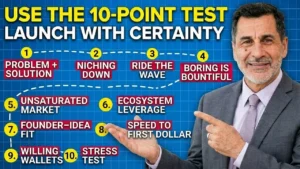
This article will walk you through a 10-point consulting business idea validation system so you launch with clarity, not assumptions.
The Mindset Shift: Treat Your Idea Like a Hypothesis
Before we get into the system, there’s one shift you need to make.
Your idea is not your identity. It’s a hypothesis.
Early in my career, my cofounder and I built an online training platform for marketing managers.
We invested time, money, and energy—only to discover there was little demand.
What worked instead?
High-touch, in-person training at $10K per session.
The pivot only happened when we stopped defending the idea—and started listening to the market.
Stop Guessing Your Offer: A 10-Point System to Validate Your Consulting Idea (Key Highlights)
You’ve got the skills — but you’re still guessing how to turn them into a profitable business.
Without a system to stress-test your idea, you’re squandering your time and gambling with your income.
In this article, I outline the 10-point business idea validation system that I’ve built and used with over 250 consultants — so you can craft an offer you’re proud (and ready) to sell and launch your business this year.
1. Problem + Solution
If there’s no clear pain point, there’s no urgency to buy.
Weak: “I help companies create better content.”
Strong: “We help HR leaders reduce employee turnover through onboarding systems.”
Application:
- Identify a measurable pain (time, money, risk)
- Validate it through conversations, not assumptions
2. Niching Down
Generalists get ignored. Specialists get chosen.
Application Table:
| Broad | Narrow |
| Marketing consulting | SEO for law firms |
| Business coaching | Pricing strategy for SaaS founders |
3. Ride the Wave
Timing matters.
Markets driven by trends (AI, compliance, remote work) create urgency.
Ask:
- Is demand increasing or declining?
- Am I aligned with where the market is going?
4. Boring is Bountiful
The most profitable ideas are often the least exciting.
Example:
Reselling analytics tools helped scale my company to 8 figures.
Application:
Look for:
- Compliance
- Reporting
- Operational inefficiencies
5. Unsaturated Market
You don’t need a new idea—you need a different angle.
Application:
- Study competitors
- Identify gaps in positioning
- Define a clear niche
6. Ecosystem Leverage
Don’t build from zero if you don’t have to.
Platforms like Salesforce, Shopify, and HubSpot come with built-in demand.
Application:
Align your offer with:
- Existing tools
- Established marketplaces
- Trusted ecosystems
7. Founder–Idea Fit
A great idea in the wrong hands still fails.
Ask:
- Do I have credibility in this space?
- Am I willing to build the required skills?
8. Speed to First Dollar
Revenue is validation.
Instead of building for months, test with:
- Pilot offers
- Paid audits
- Workshops
9. Willing Wallets
Your buyer must have:
- Budget
- Authority
- Urgency
Otherwise, you’re stuck in endless conversations.
10. Stress Test
Hope is not a strategy.
Ask:
- What could go wrong?
- How long can I sustain this?
- What dependencies exist?
The biggest risk isn’t choosing the wrong idea. It’s falling in love with it before testing it.
Once you’ve gone through this idea validation process and you’re ready to speak with potential buyers, the next step is knowing what to ask.
If you’re not sure where to start, check out this article on the questions you should ask to uncover real buyer behavior.
Key Takeaways
- Don’t fall in love with your idea—treat it like a hypothesis to test
- A real, painful problem is the foundation of every viable offer
- Specific niches outperform broad positioning
- Speed to first dollar matters more than perfection
- If your buyer doesn’t have budget or urgency, the idea won’t work
- Validate before you build—or risk wasting months on the wrong offer
Download the 10-Point Business Idea Validator and run your idea through it before you invest another hour.