26 Ideas to Start a Consulting Business in 2026 (With Difficulty & Speed to First Dollar)

I’m on my seventh venture now—including an 8-figure consulting firm I built and eventually sold to the global media company dentsu—and I can tell you something about business ideas: finding them is both very easy and very hard.
If you’re looking for ideas to start a consulting business in 2026, you’ll find no shortage of them.
That’s because, as the saying goes, ideas are a dime a dozen. If you pay attention in your day-to-day work and life, you’ll constantly notice problems, inefficiencies, and frustrations waiting for someone to solve them.
But finding viable ideas is harder.
First, viability depends on real market demand. An idea might sound clever, but if businesses aren’t willing to pay to solve that problem, it’s not a business.
Second, viability is affected by external forces you can’t control—technology shifts, regulatory changes, economic cycles. What looks promising today can become irrelevant tomorrow.
And third—and this is the factor most people overlook—there’s the question: is this idea actually a good fit for you?
Of course, every entrepreneur needs to learn new skills. But when you can match a real market need with the skills, experience, and industry knowledge you already have, your odds of success increase dramatically.
That’s exactly why I created this list.
If you’re looking for ideas to start a consulting business in 2026, here are 26 possibilities—organized with filters that actually matter.
26 Ideas to Start a Consulting Business in 2026
Below, I’ve grouped the business ideas into six categories. For each idea, I outline:
- The past experience that helps
- New skills you might need to acquire
- Difficulty level
- And how fast you could realistically earn your first dollar
The goal isn’t just to give you ideas, it’s to help you identify the ones that actually make sense for you.
Category 1: Tech & Transformation
This category thrives on operational pain. Automation. Systems. Efficiency.
If you’ve worked inside operations, IT, analytics, logistics, healthcare systems, finance — you’re closer than you think.
You don’t need to become an AI engineer, you need to solve business friction.
Example
A mid-level operations manager who automated reporting internally started offering workflow automation for small firms.
Ideas:
- AI Workflow & Implementation
- AI Training & Adoption Coaching
- Cloud Migration & Optimization
- Digital Transformation Strategy
- Manufacturing & Industry 4.0
- Operational Excellence & Process Improvement
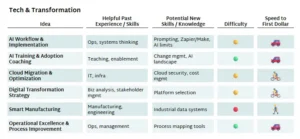
Who this is best for:
Operators, system thinkers, people who hate inefficiency.
Category 2: Content & Creator Economy
This isn’t about becoming an influencer.
It’s about building systems for people who already have audiences or expertise.
These models are especially strong right now because knowledge monetization continues to rise.
Example
A corporate trainer built online certification programs for subject matter experts. She never became a YouTuber. She built infrastructure for those who were.
Ideas:
- Creator Economy Strategy
- Online Education & Training Systems
- Subscription & Recurring Revenue Models
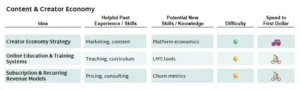
Who this is best for:
People with teaching, marketing, or packaging experience
Category 3: People & Workplace
Hybrid work is not going away.
And companies are still struggling with productivity, hiring, and culture alignment.
Example
An HR manager launched a remote onboarding consulting service for tech startups.
Ideas:
- Remote Work Productivity & Culture
- HR & Talent Strategy
- Offline Community & Anti-Doomscroll Strategy
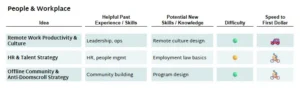
Who this is best for:
Team leaders, HR professionals, program managers.
Category 4: Risk, Compliance & Sustainability
This category is slower but powerful.
If you understand regulation, governance, finance, or cybersecurity, you have leverage.
Example
A compliance officer pivoted into AI governance consulting when new regulations hit. Demand wasn’t flashy — it was urgent.
Ideas:
- Compliance Consulting (AI, Data, Privacy)
- IT & Cybersecurity Consulting
- ESG & Sustainability Strategy
- Financial Services & Fintech Advisory
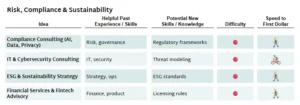
Who this is best for:
Risk-aware professionals with industry depth.
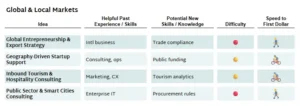
Category 5: Global & Local Markets
Globalization and localization both create opportunity.
Expansion, smart cities, tourism, export strategy — these aren’t trends. They’re infrastructure shifts.
Example
A former export manager now helps mid-sized U.S. manufacturers navigate regulations and logistics when expanding into Latin American markets.
Ideas:
- Global Entrepreneurship & Export Strategy
- Geography-Driven Startup Support
- Inbound Tourism & Hospitality Consulting
- Public Sector & Smart Cities Consulting
Who this is best for:
International professionals, public sector insiders, ecosystem builders.
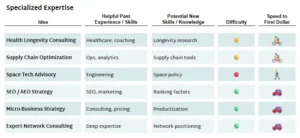
Category 6: Specialized Expertise
Sometimes your narrowest knowledge is your biggest opportunity; don’t underestimate depth.
Example
A supply chain director who spent 15 years in manufacturing now consults with small e-commerce brands to redesign their inventory and fulfillment processes.
Ideas:
- Health Longevity Consulting
- Supply Chain Optimization
- Space Tech Advisory
- SEO / GEO Strategy
- Micro-Business Strategy
- Expert Network Consulting
Who this is best for:
Industry specialists who don’t want to generalize.
How to Choose Among the 26
Don’t chase the “best” idea, find the best idea for you.
Filter by:
- Founder–Idea Fit
- Speed to First Dollar
- Market Demand
The worst outcome isn’t picking wrong; it’s bouncing between shiny objects for six months and never starting.
You don’t need a new identity.
You need:
- A clear problem
- A specific audience
- The courage to package what you already know
Watch the full video breakdown where I show you how to vet these ideas before committing.