The 4 Sales Call Mistakes That Quietly Cost Consultants Clients

Winning a consulting engagement rarely comes down to a clever proposal or a polished presentation.
More often, the outcome is shaped long before the proposal is written. Every sales call either builds trust or gradually erodes it. Buyers don’t simply evaluate your expertise. They’re deciding whether they trust you with a business problem that carries financial, operational, and sometimes personal consequences.
After decades of selling consulting services, contributing to more than $70 million in sales, and reviewing dozens of consultant sales calls, I’ve found that the same mistakes appear repeatedly. They aren’t dramatic mistakes. They are subtle flaws that feel perfectly reasonable while the conversation is happening.
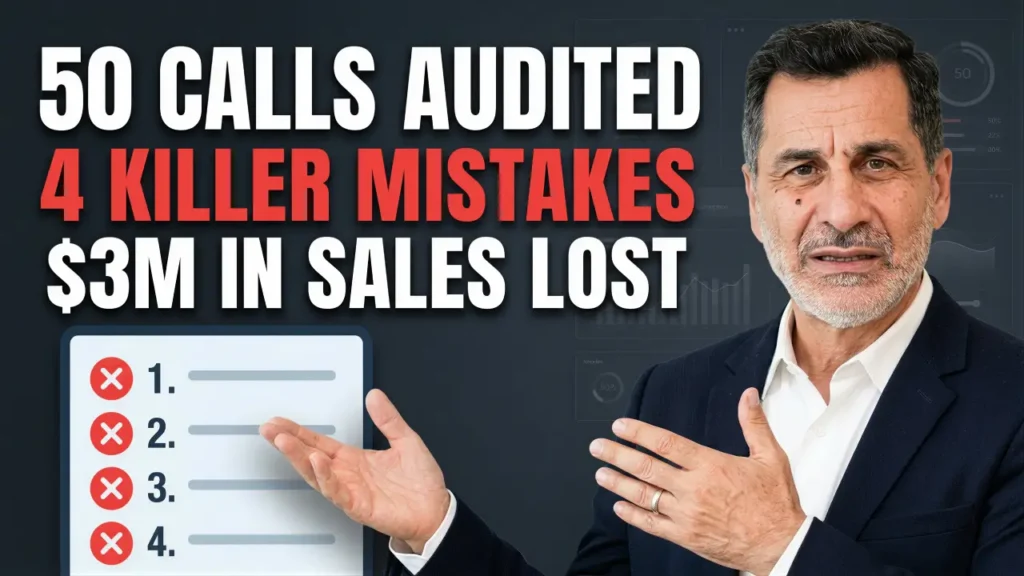
I’ve also recorded a companion “I Audited 50 Sales Calls” YouTube video that walks through each mistake in greater detail.
Mistake #1: Over-Talking the Buyer
Silence is often a buying signal, not a warning sign.
One of the most common patterns I observed was surprisingly simple: As soon as buyers became quieter, consultants started talking more.
Additional explanations followed, more examples, more reassurance.
Most consultants interpret silence as uncertainty or hesitation. In reality, buyers are frequently processing information, considering budget implications, or thinking about how they will explain your recommendation internally.
Giving buyers space often produces better conversations than filling every pause.
Practical application
| Instead of… | Try… |
| Explaining your value again | “What’s your reaction so far?” |
| Filling every silence | Allow a few seconds before speaking again |
| Offering another example | “What questions are coming to mind?” |
Listening creates opportunities that talking often misses.
Mistake #2: Solving the Problem Too Early
Discovery should uncover before it recommends.
Early in my consulting career, I believed clients hired me because I had answers. That belief caused me to recommend solutions far too quickly. Over time I realized buyers became much more receptive after they felt completely understood.
A simple diagnostic helped improve my discovery conversations.
Three layers to uncover before recommending a solution
| Layer | Objective |
| Current problem | Understand the business challenge |
| Previous attempts | Learn what has already been tried and why it failed |
| Business impact | Understand what happens if nothing changes |
By the time you understand all three layers, your recommendation will usually feel like a logical conclusion instead of a sales pitch.
Once you get to know the lead better, and rapport is established, one of my favorite questions is:
“Is there any internal friction you’re hoping this project will eliminate?”
That question often opens conversations about missed goals, leadership pressure, departmental conflict, or organizational priorities that would never appear on a requirements document.
Mistake #3: Ignoring the Hidden Buying Team
Your buyer rarely buys alone.
One lesson took me years to appreciate.
The person sitting across from you usually isn’t making the decision alone. They may become your champion, but they still need to persuade colleagues who evaluate your proposal through entirely different perspectives.
Gartner ran a survey on B2B enterprise buying teams, and the average number of people involved in a B2B buying decision is sitting north of 10 now, and on bigger deals it’s stretching closer to 20. (If you’re selling to small and medium-size businesses, the number will be smaller, but the same principle applies: your main point of contact is almost never the only one involved in the buying decision).
Finance evaluates investment, operations evaluates implementation, legal evaluates risk, and leadership evaluates business outcomes.
Helping your champion navigate those conversations often determines whether your proposal survives the internal buying process.
Create a Champion Enablement Pack
After important discovery calls, consider sending a concise document that your champion can easily forward internally.
| Stakeholder | Information to Include |
| Finance | ROI, expected return, cost of inaction |
| Operations | Timeline, required resources, implementation approach |
| Legal | Contract overview, security, risk management |
| Leadership | Strategic benefits and measurable outcomes |
A well-prepared champion becomes far more effective than one relying on memory alone.
Mistake #4: Leaving Without Clear Next Steps
Momentum should never depend on assumptions.
Another pattern appeared during the final few minutes of many calls.
The meeting ended with statements like: “I’ll send a proposal next week.” or “Let’s reconnect soon.”
Everyone left feeling positive.
Unfortunately, neither side shared the same understanding of what would happen next.
The consultants who consistently maintained momentum treated the last few minutes of every meeting as carefully as the first.
They built agreement around specific actions before ending the conversation.
Build a mutual action plan
Before ending your discovery meeting, confirm:
| Question | Purpose |
| What are the next three steps? | Creates a shared process |
| Who owns each action? | Establishes accountability |
| When should each step happen? | Maintains momentum |
| Who else should be involved? | Expands visibility inside the client organization |
Your mutual action plan could look something like this:
| Next Step | Owner | Due Date | Notes |
| Send proposal | Consultant | March 31 | |
| Share proposal internally | Main contact | April 2 | Include Finance, Legal, and Ops |
| Proposal walkthrough | Main contact, consultant | April 9 | Main contact to invite one or two members from each internal department |
With a simple plan such as this, follow-ups stop feeling like nudges and start feeling like progress check-ins on something both of you actually committed to.
What Changed My Own Sales Process
Looking back over my own consulting career, I can identify dozens of discovery calls I would handle differently today.
Early on, I believed success came from proving how much I knew. I wanted buyers to leave convinced that I had the expertise to solve their problem. Experience taught me something much more valuable.
The best discovery calls rarely feel like presentations, they feel like collaborative conversations where buyers leave thinking:
“This person really understands our situation.”
That shift, more than any sales strategies, tactics, or tips, changed the way I approached consulting sales , and over time it changed my close rates as well.
Key Takeaways and Actions
Small improvements in discovery conversations often produce meaningful improvements in close rates. Before your next client meeting:
- Allow buyers time to think before filling silence.
- Continue asking discovery questions after you believe you understand the problem.
- Identify everyone involved in the buying decision, not just your primary contact.
- End every meeting with documented next steps, owners, and timelines.
- Review recordings of your sales calls whenever possible. Patterns become much easier to recognize after the conversation has ended.
You can also watch my companion “I Audited 50 Sales Calls” YouTube video, where I cover these four mistakes with real consulting examples and show you exactly how to avoid them during your next client conversation. In the video, I also walk you through the Sales Call Evaluation Checklist that you can download and use to review your next discovery call.