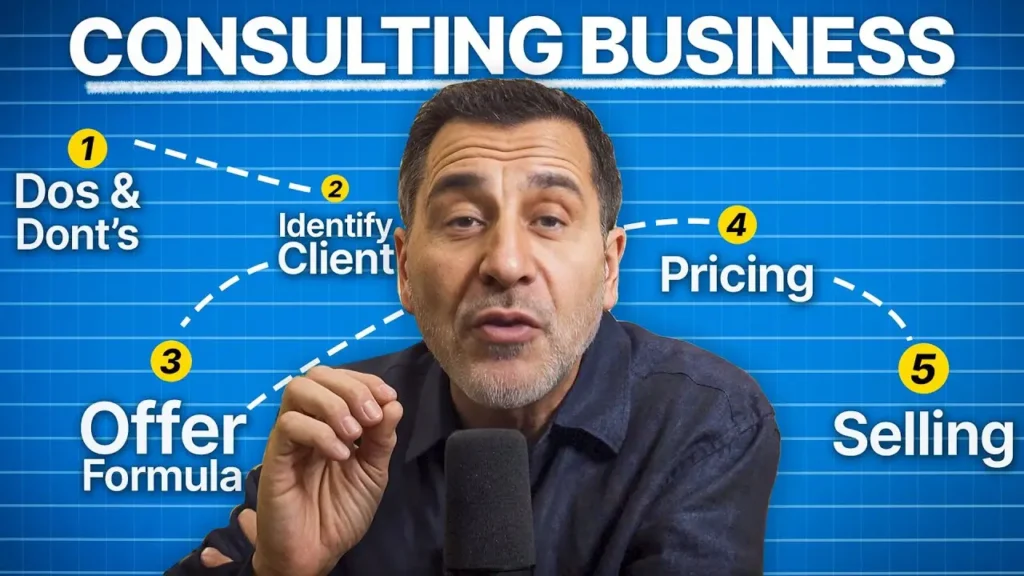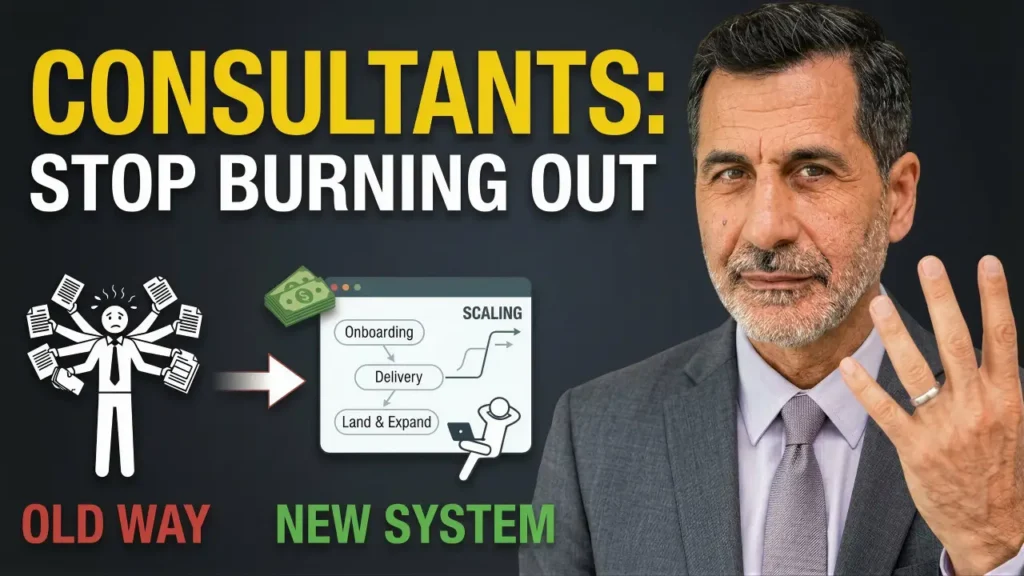
How to Start a Consulting Business in 2026: A Step-by-Step Guide

Starting a consulting business is one of the most accessible ways to build a business today. You already have experience, you’ve solved real problems, and at some level, people trust your judgment. The challenge is that you still have to translate what you know into something people will pay for; the challenge is how to start a consulting business.
Over the past 20+ years, I’ve built seven businesses, mostly in consulting, generated over $70 million in revenue, and scaled a firm to eight figures before selling it to a global media giant. What I’ve consistently seen is that most capable professionals don’t struggle because of a lack of skill—they struggle because they don’t have a clear path from experience to execution.
This guide is designed to give you that path. It’s practical, grounded, and built around what actually works in today’s consulting landscape.
I also cover this entire framework in detail in my YouTube video: The Ultimate Guide to Starting a Consulting Business in 2026.
What Consulting Really Is (And Why Most People Overcomplicate It)
At its core, consulting is straightforward. You help someone solve a problem they care about, and they pay you for it. There’s no need to romanticize it or overcomplicate it with jargon.
You don’t need decades of experience or elite credentials to begin. What you do need is enough knowledge to help someone move from where they are today to a better outcome—faster, more efficiently, or with fewer mistakes.
And while some would-be founders feel they are too early in their careers, others feel they’ve waited too long. In reality, both positions can be advantages. Early in your career, you often have more time and flexibility and less obligation. Later in your career, you do bring experience, credibility, and a stronger network.
I personally entered entrepreneurship at 37 after a layoff, so I guess somewhere between early career and later career. It wasn’t planned, and it certainly wasn’t comfortable. But it reinforced a key lesson: the decision to start matters far more than the timing.
Turning Your Skills Into a Clear Consulting Offer
The transition from “I have skills” to “I have a business” happens when you define your offer clearly. This is where many aspiring consultants get stuck, often because they try to start with branding or positioning before they’ve done the foundational work of formulating an offer.
A simple way to approach this is through a three-part framework:
| Component | Description |
| Skill | What you already know how to do |
| Problem | A real issue someone is facing |
| Willing Wallets | People who are ready to pay to solve it |
Your goal is to connect these three elements in a practical way.
Start by listing out your skills without overthinking. Look at your professional experience, the types of problems you’ve solved repeatedly, and the areas where others ask for your advice. This could include operations, hiring, IT, finance, marketing, or systems. Many people underestimate how valuable their existing experience already is.
Once you have a list, shift your focus to the problems those skills solve. Clients are not interested in your capabilities in isolation—they care about outcomes. A hiring expert doesn’t sell “hiring services”; they solve the problem of bad hires. An IT consultant doesn’t sell infrastructure—they reduce downtime and risk.
| Skill Area | Problem | Solution |
| Hiring | Poor team performance | Build structured hiring systems |
| IT Infrastructure | Frequent outages | Modernize and stabilize systems |
| Operations | Inefficiency | Streamline processes and reduce waste |
Validating the Offer
Finally, validate whether people are actually willing to pay for these solutions. Instead of guessing, talk to potential customers. A simple approach is to speak with around 10 people who fit your target profile and study 5 competitors in your space. This combination gives you direct insight about your market. I have a 10+5 worksheet with sample data to help you through this exercise, you can download here.
During those conversations, focus on understanding their frustrations, what they’ve tried, and what they’re currently paying for. That level of understanding becomes the foundation of your offer.
Defining Your Ideal Client Without Over-Narrowing
Your offer and your ideal client typically take shape together over time. As you better understand the problems you solve and the people who need help solving them, your positioning becomes sharper and more focused. This is where the concept of an Ideal Client Profile (ICP) becomes critical.
Many new consultants fall into the trap of trying to appeal to everyone, which usually leads to vague messaging and weak traction. As I always say, if you sell to anyone, you sell to no one!
A more effective approach is to define your audience with enough specificity to guide your decisions, while still leaving room to adapt.
In a B2B setup, your ICP should include elements such as:
- Industry or sector
- Stakeholders involved in the decision-making process
- Company size or stage
- Key challenges and priorities
This level of clarity helps you focus your marketing and sales efforts on people who are most likely to need and value your service.
At the same time, it’s important not to over-restrict yourself early on. Your initial positioning should be focused, but flexible. As you start working with clients and receiving feedback, the market will naturally guide you toward a more refined niche.
If you’re looking for additional guidance on how to better define your ICP, check out this article I have on how to conduct market research.
Choosing a Consulting Business Model That Fits Your Stage
Your consulting business model determines how you deliver your service and how you scale your business. In the beginning, simplicity is more valuable than optimization.
One useful way to think about this is along two dimensions: volume vs. value, and level of involvement.
In a volume-based model, you serve many clients at a lower price point, often using standardized or productized services. In a value-based model, you work with fewer clients at a higher price point, offering more customized solutions.
Another important distinction is how the work is delivered:
| Model | Description | Scalability |
| Done For You (DFY) | You handle the work | Lower |
| Done With You (DWY) | Collaborative approach | Moderate |
| Do It Yourself (DIY) | You guide, client executes | Higher |
You don’t need to commit to a single model permanently. Many successful consultants combine these approaches over time. Early on, the goal is simply to choose a model that aligns with your skills and allows you to start serving clients.
Pricing Your Services With Clarity and Confidence
Pricing your consulting services is one of the most uncomfortable areas for new consultants, often because it feels subjective and risky. The key shift is understanding that clients are not paying for your time—they are paying for the value of the outcome.
There are several common consulting pricing models, including hourly, project-based, value-based, retainers, and productized services. Each has its place, but for consulting business beginners, hourly or project-based pricing tends to be the most straightforward.
Calculating Hourly Rate
A simple formula to establish a baseline hourly rate is:
(Desired Income + Expenses) ÷ Billable Hours
Let me walk you through a real scenario.
A founder I worked with, Andy, said: “I want to make $10K a month.” We roughly have 160 hours/month (40 hours a week for 4 weeks), so divide $10K by 160 hours…. Nope, that’s not how it works.
Your hourly rate isn’t about filling your calendar.
Your rate has to support your goals. And to do that, you need to understand something most new consultants miss:
Only a fraction of your time is billable. On average, you’ll bill about 60% of your hours. The other 40% goes into marketing, sales, proposals, admin, back-office tasks — all the things you now do as a business owner.
So here’s the right way to calculate your rate. Your hourly rate comes from a simple formula:
Hourly rate = Total monthly revenue target ÷ Total monthly billable hours.
Let’s walk through Andy’s numbers so you can see how this works.
His monthly revenue target is $10,000.
If he can realistically bill 96 hours this month, the math looks like this:
$10,000 ÷ 96 ≈ $104 an hour. (Round that up to $110/hour for some breathing room.)
Now, here’s what goes into that $10,000 number.
Your revenue target should include three things:
1- Business expenses — your tools, software, subscriptions, insurance, overhead, etc.
If it’s easier, calculate annually and divide by 12. Andy: $3,500/month
2- Your take-home pay — what you actually want to bring home, and include taxes in your calculations.
Andy: $5,000/month
3- Profit — not optional. Profit is how you reinvest, grow, and create stability.
Andy: $1,500/month
Add all that up and you get his revenue target of $10,000.
That number sets your floor. Charge less, and you’re underwater.
Now, for those of you who are ambitious, if you want to earn more than $10,000 a month, you either raise your rate or increase your billable hours.
Early on, I recommend focusing on expanding your billable-hour pool. For example, instead of working 40 hours a week, plan on working 60 hours.
If 10 of those additional 20 hours are billable, again at $125 an hour, that’s an extra $1,250 a week, or bang… $5,000 in additional revenue a month.
Either way, I have an hourly pricing worksheet you can download and make your own and play out different scenarios, check out the link in the description.
This gives you a starting point, not a final answer. As you gain experience and confidence, you can move toward value-based pricing, which often reflects the impact of your work more accurately.
In my own experience, I’ve used nearly every pricing model. Over time, I leaned toward value-based pricing because it aligns better with results. However, early on, the priority is not optimization—it’s getting clients and building experience.
If you like to explore other pricing types, check out my ultimate guide to pricing for consultants video.
In your earliest stages, don’t worry about pricing; just sell.
When you’re working to close your first deals, stay very flexible on pricing, type of client, and even the service the client asks you to deliver. Momentum, revenue, and delivery experience are more important at this point than the specifics of a deal. As you gain more experience with delivery and sales, you can be more discriminating and begin charging more.
Marketing and Sales: Building Your First Client Base
For many professionals, sales and marketing feel like unfamiliar territory. It’s common to believe that you need advanced tactics, a strong personal brand, or a sophisticated funnel to get started. In reality, your first clients are usually much closer than you think.
The most consistent pattern I’ve observed across hundreds of consultants is that their early clients come from their existing network. Former colleagues, industry contacts, and acquaintances often become the first opportunities.
A practical approach is to reconnect with these contacts intentionally. This involves reviewing your network, identifying people who could benefit from your services or refer you, and reaching out with a simple, genuine message. The goal is not to sell immediately, but to start conversations.
This process can feel uncomfortable at first, especially if you’re not used to initiating these types of discussions. However, like any skill, it improves with repetition. Sales is less about persuasion and more about understanding needs and offering relevant solutions.
As you gain momentum, you can expand into other marketing channels such as events, content, and partnerships. Early on, however, direct outreach and real conversations provide the fastest path to your first clients.
To help you in the outreach process, I have this template with sample outreach tips and messages for warm and cold contacts.
Delivering Value and Building Long-Term Relationships
Closing a deal is only the beginning. The real work—and the real opportunity—comes from delivering results.
Strong delivery builds trust, generates referrals, and creates the foundation for long-term growth. It requires clarity in communication, structured onboarding, and consistent follow-through.
In my experience, preparedness and discipline are the two most important factors in delivering high-quality work. These are principles I’ve carried from martial arts into business. They show up in how you plan projects, manage expectations, and respond to challenges.
Your first few clients are especially important. They become your initial case studies, testimonials, and references. Investing extra effort to ensure their success pays dividends in the form of credibility and future opportunities.
Check out my ultimate guide to delivering (from onboarding to servicing to scaling).
The Operational Foundation of Your Consulting Business
As your consulting business grows, you’ll need more than clients and revenue. You’ll also need the operational systems that keep the business organized, protected, and financially healthy. While this side of the business may not feel as exciting as sales or delivery, it becomes increasingly important as you grow.
Key areas to put in place include:
- Choosing a business entity (e.g., LLC or S-Corp)
- Opening a separate business bank account
- Setting up bookkeeping and invoicing systems
- Creating standard contracts and agreements
- Understanding tax obligations
You don’t need to implement everything at once. The goal is to build awareness and gradually put the right systems in place.
One important recommendation is to invest in professional support where needed. A good accountant or legal advisor can prevent costly mistakes and save significant time in the long run.
Using AI and Technology to Accelerate Your Growth
Technology, particularly AI, has made it easier than ever to start and operate a consulting business. It can support a wide range of activities, from research and content creation to client communication and process automation.
At the same time, it’s important to use these tools thoughtfully. Relying entirely on AI without developing your own thinking can limit your growth. A better approach is to use AI to enhance your capabilities rather than replace them.
Practical applications include:
- Conducting market research
- Refining your offer and messaging
- Drafting winning proposals
- Creating content and documentation
- Streamlining internal processes
Used correctly, these tools can significantly increase your efficiency and allow you to focus on higher-value activities.
Key Takeaways
- Consulting is about solving real problems that people are willing to pay for
- Your offer must connect skills, problems, and demand
- Early traction comes from focused outreach, not complex marketing
- Pricing evolves over time; start simple and refine as you grow
- Strong delivery builds the foundation for long-term success
- Systems and structure support sustainable growth
- Action is what creates clarity—not the other way around
Next Steps
If you’re serious about starting your consulting business, the next step is simple: take action.
Watch the full video walkthrough here: 👉 The Ultimate Guide to Starting a Consulting Business in 2026
You’ll also find templates, worksheets, and resources mentioned throughout this guide that you can use to start immediately.
Don’t wait to feel ready. You build readiness by starting.