
The Ultimate Guide to Sales for Consultants Who Hate Selling

Most consultants do not fail because they lack sales expertise. They fail because they never develop the discipline of sales.
Over the years, I have spoken with hundreds of consultants who are technically exceptional and capable problem-solvers. Yet when it comes to client acquisition, they stall. They hesitate to reach out. They overthink their pitch. They wait for referrals. They convince themselves that good work will “naturally” attract clients.
It rarely does.
When I started my first consulting business, I had zero formal sales training. I came from a project and operations background. I knew how to deliver. I did not know how to sell. Over time, through repetition, mistakes, and structure, I built and sold an eight-figure consulting firm and generated over $70 million in revenue.
The difference was not charisma. It was sales discipline.
This article breaks down the practical components of that discipline and shows you how to apply them.
1. Reframe Your Identity: You Are Not a Salesperson
The first barrier most consultants face is psychological.
They associate “sales” with pressure, manipulation, or awkward negotiation. In reality, consulting sales is structured problem-solving.
If you have worked in a corporate environment, you have already sold:
- You pitched ideas.
- You defended budgets.
- You advocated for promotions.
- You persuaded stakeholders.
Consulting sales is the same activity applied externally.
2. Stop Talking. Start Listening.
One of the biggest mistakes new consultants make is speaking too much (I was in this category myself 😀).
Research from companies such as Gong shows that top-performing sales professionals speak approximately 40% of the time in a sales call. The rest of the time, they listen.
Some new consultants often reverse this ratio. They list services, explain processes, and attempt to prove competence. The result is overwhelming.
Sales for consultants is diagnostic, not performative. Before presenting services or solutions, clarify:
- What prompted this conversation?
- What happens if this problem is not solved?
- What has already been attempted?
- Who else is involved in the decision?
Active listening builds trust. It also improves proposal accuracy and increases close rates.
3. Your Pitch Is About Outcomes, Not Services
When someone asks, “What do you do?” The wrong answer is a job title.
“I’m a marketing consultant” is vague and forgettable.
A stronger framing follows this structure:
| Weak Pitch | Strong Pitch |
| I run a consulting firm | I help B2B founders generate predictable inbound leads |
| We provide analytics services | We help companies turn marketing data into actionable growth decisions |
The goal of your initial pitch is not to close a deal. It is to earn the next conversation.Develop two versions:
- A 10-second version for informal interactions.
- A 30-second version for more structured conversations.
Refine them continuously based on real-world feedback.
4. Repetition Builds Confidence
Confidence is not a personality trait. It is a byproduct of repetition. I used to build my own sales muscle at home by practicing pitches tirelessly.
You can record yourself delivering your pitch. Improve one element. Repeat. Seek feedback. And start practicing in lower-stakes environments.
I recommend you start off with a focus on warm contacts:
- Former colleagues
- Vendors
- Industry peers
- Adjacent professionals
Inform them clearly and professionally about your consulting focus. Apart from sharpening your messaging, these discussions sometimes actually generate early opportunities.
Other less personal marketing channels have their place. But early momentum is built through direct interaction.
5. Understand the Sales Funnel
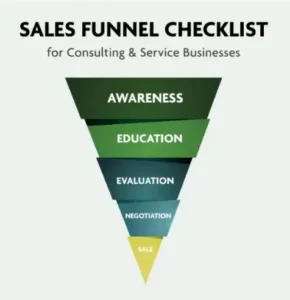
Sales for consultants, and sales in general, requires structure. While sales conversations are rarely linear, every deal moves through identifiable stages, here are the 5 stages that deals typically go through.
| Stage | Purpose |
| Awareness | Lead discovers you and initial qualification occurs |
| Education | Problem clarification and relevance established |
| Evaluation | Comparison with alternatives and internal discussion |
| Negotiation | Scope, pricing, and timeline alignment |
| Commitment | Contract execution and payment |
Even if conversations move back and forth, each component must be addressed. Skipping a stage weakens the deal. If you’re new to the concepts of sales process and sales funnel, check out my article on The Ultimate Guide to Sales Funnels for Consultants.
6. Track Pipeline Math
Some things in business are hard to measure, but sales performance is measurable. Let me explain:
If you close 20% of qualified opportunities and need two clients per month, you need ten qualified opportunities.
So at a minimum, start tracking:
- Leads
- Qualified opportunities
- Demos or discovery calls
- Proposals sent
- Deals closed (win rate)
This data identifies bottlenecks. For example:
- High lead volume but low demo and proposal suggests weak qualification.
- High proposal volume but low close rate suggests misaligned proposals or pricing issues.
Early on, ignore industry benchmarks. My early win rate was approximately 1 in 20. Through practice and refinement, it improved to roughly 1 in 3.
Once you start tracking, you can begin analyzing and optimizing.
7. Recognize That All Sales Is Emotional
Even in B2B environments, decision-making is emotional. Most buyers, like the rest of us, justify with logic but decide with emotion.
What do I mean by emotion? Business owners and decision makers might experience:
- Desire for growth
- Reputation vulnerability
- Reluctance to share control
- Fear of making a losing decision
A CFO reviewing your proposal may analyze ROI. But underneath that logic sits a personal question: “Will this decision make me look competent or reckless?”
Address emotion by:
- Reducing perceived risk (e.g. outcomes are tangible)
- Clarifying the cost of inaction
- Demonstrating understanding of their stakes
- Providing credible proof
Ignoring the emotional layer weakens persuasion.
8. Practice Proposal Discipline
A proposal is not marketing material; it is an alignment document. Before rushing to send a proposal, ensure you’ve, at least, captured the following in your previous interactions with your lead:
- The lead’s need is clearly diagnosed.
- Budget has been discussed.
- Decision makers are identified.
- Urgency is confirmed.
And then when you develop your proposal, it will resonate better with the lead, since it now reflects:
- The exact problem.
- The desired outcome.
- Defined scope.
- Clear next steps.
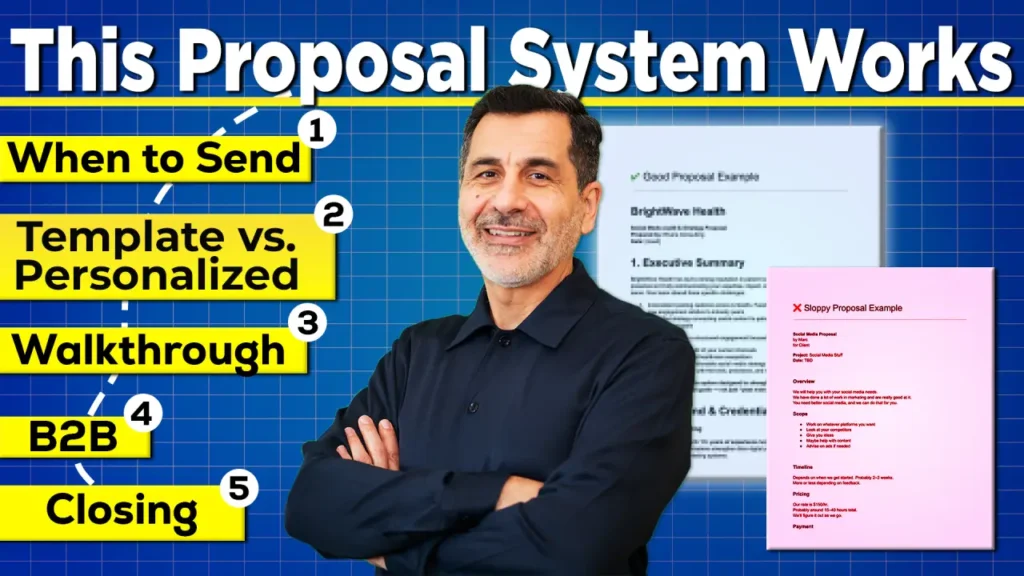
For a deeper breakdown of proposal strategy and structure, watch my full video guide on winning consulting proposals.
Applying This Framework
Sales skill in consulting is built through disciplined action:
| Area | Immediate Action |
| Identity | Track conversations per week |
| Listening | Prepare layered discovery questions |
| Pitch | Develop 10- and 30-second versions |
| Activation | Contact 10 warm connections this week |
| Pipeline | Track five core metrics |
| Proposals | Align with diagnosed pain and urgency |
These actions compound over time.
Takeaways
- Sales is a discipline, not a personality trait.
- Listening increases conversion more than speaking.
- Traction precedes optimization.
- Pipeline math removes guesswork.
- Emotion drives decisions, even in B2B.
- Proposals must reflect alignment, not aspiration.
If you want to see this framework broken down step-by-step in video format — including examples, templates, and real-world scenarios — watch the full video here.
The consultants who build sustainable businesses are rarely the most charismatic. They are the most disciplined.