The Founder’s Mentality: What Early-Stage Consultants Can Learn from Late-Stage Companies

I recently revisited The Founder’s Mentality by Chris Zook and James Allen.
At first glance, it’s a book written for large organizations—companies dealing with layers of management, global expansion, and operational complexity. Not exactly the world of a new consulting firm trying to land their first few clients.
But as I worked through the book, something stood out: many of the issues it highlights are just as relevant to new businesses. In my experience, these problems don’t suddenly appear when companies scale. They start much earlier.
This article breaks down how early-stage founders—especially those building consulting or service businesses—can tackle these issues before they become harder to reverse.
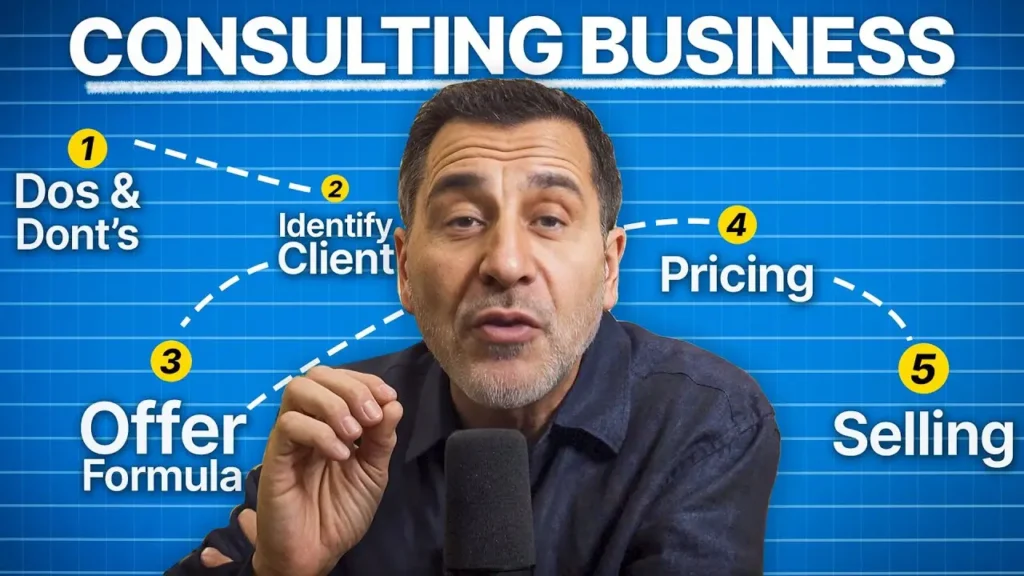
I also covered this topic in a recent video.
The Paradox of Growth Starts Earlier Than You Think
One of the central ideas in the book is simple but powerful: growth creates complexity, and complexity kills growth.
For large companies, this shows up as bureaucracy, slow decision-making, and disconnected teams. For early-stage founders, it shows up differently—but the root issue is the same.
In the early days of my own consulting business, I remember reaching a point where things felt busy but not productive. We had multiple service offerings (web hosting, web design, web development, SEO, search marketing, etc.), different types of clients, and lots of tools and processes for a team that was still small. On paper, it looked like progress. In reality, it was the beginning of unnecessary complexity.
We weren’t scaling yet, but we were already feeling the friction. Complexity doesn’t wait until you’re “big enough.” It creeps in as soon as you start adding more than you can manage with clarity.
The Hidden Cost of Overcomplication
Complexity in early-stage businesses is rarely warranted. It’s self-imposed.
It often comes from good intentions, but each addition carries a cost.
| Area | Simple Approach | Overcomplicated Approach |
| Services | 1–2 clear offers | Multiple unclear packages |
| Tools | A few essential tools | Fragmented tech stack |
| Sales | Direct conversations | Complex funnels too early |
| Delivery | Clear scope and outcomes | Over-engineered workflows |
Complexity compounds over time. The earlier you recognize it, the easier it is to correct.
Founder vs. Employee: The Mindset That Shapes Growth
The book clearly distinguishes the mindset of a founder from that of an employee. The authors describe it as the difference between an owner and a caretaker (or a parent and a babysitter).
For an early-stage consultant, this translates into how you approach your business on a daily basis.
| Founder Mindset | Employee Mindset |
| Takes ownership of outcomes | Focuses on tasks |
| Acts with urgency | Waits for clarity |
| Challenges assumptions | Follows existing processes |
| Thinks long-term value | Thinks short-term completion |
In the early stages, you don’t have the luxury of operating only as an employee in your own business. You are responsible for everything—from generating demand to delivering results.
Staying Close to the Front Line
In large organizations, losing touch with the front line means executives becoming disconnected from customers.
For a consultant or small business owner, the front line is much simpler: it’s your client.
Yet many founders unintentionally distance themselves. They get pulled into administrative tasks or get too engrossed in strategy, and without realizing it, they spend less and less time with clients and prospects.
The further you move away from real conversations, the harder it becomes to understand what clients actually need, how they think, and how to position and deliver your services effectively.
Speed as a Competitive Advantage
Another recurring theme in the book is speed.
Large companies lose their edge when decision-making slows down. Early-stage businesses lose momentum for the same reason, even if the context is different.
In consulting, speed shows up in areas like:
- Making decisions about offers and positioning
- Responding to leads
- Moving prospects closer to a closed deal
Many founders wait for perfect information before acting. They research, analyze, and plan—often longer than necessary.
The reality is that early-stage growth for consultants comes from action, not optimization.
Speed does not mean recklessness. It means reducing unnecessary delays between decision and execution.
Internal Barriers Are the Real Constraint
A common assumption among new founders is that external factors are the main obstacle:
- Market competition
- Economic conditions
- Lack of demand
Each of these can be real challenges—sometimes significant ones. But they share one important characteristic: they are mostly outside your control. The authors highlight, on the other hand, that for large companies, the biggest barriers to growth are typically internal.
And I see the same pattern with early-stage founders.
Internal barriers show up as these issues, some of which we flagged above:
- Lack of clarity in the offer
- Hesitation in sales conversations
- Overcomplication in how the business is structured
- Delayed decision-making
These are not structural limitations. They are controllable factors.
And in most cases, focusing on factors within your control will have a far greater impact on growth than external conditions.
Practical Application for Early-Stage Consultants
To make these ideas actionable, it helps to translate them into concrete decisions.
| Principle | Practical Application |
| Reduce complexity | Limit your offers and focus on one clear problem |
| Stay close to the front line | Speak to clients regularly and validate assumptions |
| Maintain founder mindset | Take ownership of outcomes, not just tasks |
| Move with speed | Act on decisions without unnecessary delay |
| Reevaluate regularly | Eliminate what no longer serves your growth |
These are not advanced strategies: they are foundational disciplines. And they become harder to implement once complexity sets in.
Early-stage founders have an advantage:
- Direct access to customers
- Fewer layers of decision-making
- Greater flexibility
The challenge is to use that advantage intentionally.
Because the habits you build now—how you make decisions, structure your business, and engage with clients—become the foundation for how to scale your consulting business effectively.