
How you can shift from operator to owner

Welcome to the Dojo!
Most entrepreneurs start by doing everything themselves.
Sales. Delivery. Client communication. Administration. Problem-solving.
In the beginning, that's not only normal, it's necessary. But eventually, the very habits that helped you get your business off the ground can become the biggest obstacle to growth.
It took me years to figure this out, and I don’t want you to learn it the hard way.
On the Mat
- Let’s Train: The Hidden Growth Ceiling
- Ask Feras: “When should I start documenting my processes?”
- Sharpen the Blade: The Ultimate Guide to Service Delivery
Let's Train
The Hidden Growth Ceiling
One of the most common patterns I see among consultants and service providers is this:
The business starts gaining traction.
Clients are happy.
Referrals begin coming in.
Revenue grows.
And then growth slows down, not because demand disappears, not because competitors show up, but because the founder becomes the bottleneck.
Every decision requires their approval, every client wants to speak with them, and every proposal, deliverable, and issue flows through them.
The business becomes completely dependent on one person.
At that point, the founder doesn't really own a scalable business. They own a demanding job with employees and overhead.
I know this challenge firsthand. Over the years, we delivered more than 600 projects while growing a number of consultancies including an analytics consulting firm that eventually became an 8-figure business.
The turning point wasn't working harder. It was building systems.
The Three Levers of Scaling
When entrepreneurs think about growth, they often focus on marketing and sales. Those are important.
But growth without delivery capacity simply creates bigger problems. If you want to scale a service business, three areas deserve your attention:
1. Systematize Your Work
If your processes only exist in your head, your business cannot scale.
- Document how you onboard clients.
- Document how you deliver projects.
- Document how you communicate, report progress, collect feedback, and close engagements.
Systems create consistency, consistency creates quality, and quality creates trust.
2. Leverage Technology and AI
Technology should reduce friction, not create it.
The goal is not to collect dozens of tools, the goal is to create a simple operating system for your business.
Project management tools, documentation platforms, communication systems, meeting intelligence software, and AI assistants can dramatically improve efficiency when implemented thoughtfully.
AI, in particular, can help consultants move faster without sacrificing quality.
Not by replacing expertise, but by amplifying it.
Use AI to summarize meetings, organize information, analyze data, draft reports, and accelerate repetitive tasks so you can focus on higher-value work.
3. Learn to Delegate
For many founders, this is the hardest step.
You built the business, you understand the clients, and you know how things should be done.
So naturally, you think: "It's faster if I just do it myself."
Sometimes that's true, but it's also the mindset that keeps many businesses permanently stuck.
Effective delegation requires clear systems, clear expectations, and the right people.
Start small, delegate repeatable tasks, develop trust and expand responsibility over time.
Your goal is not to control every activity.
Your goal is to build a business that can produce results without your constant involvement.
Ask Feras Recap
🔥 The Challenge
"When should I start documenting my processes?"
🛠️ What I Told Them
Earlier than you think. Most founders wait until they're overwhelmed. Start documenting processes as soon as you find yourself repeating the same activity multiple times. Future employees, contractors, and even future-you will thank you.
Sharpen the Blade
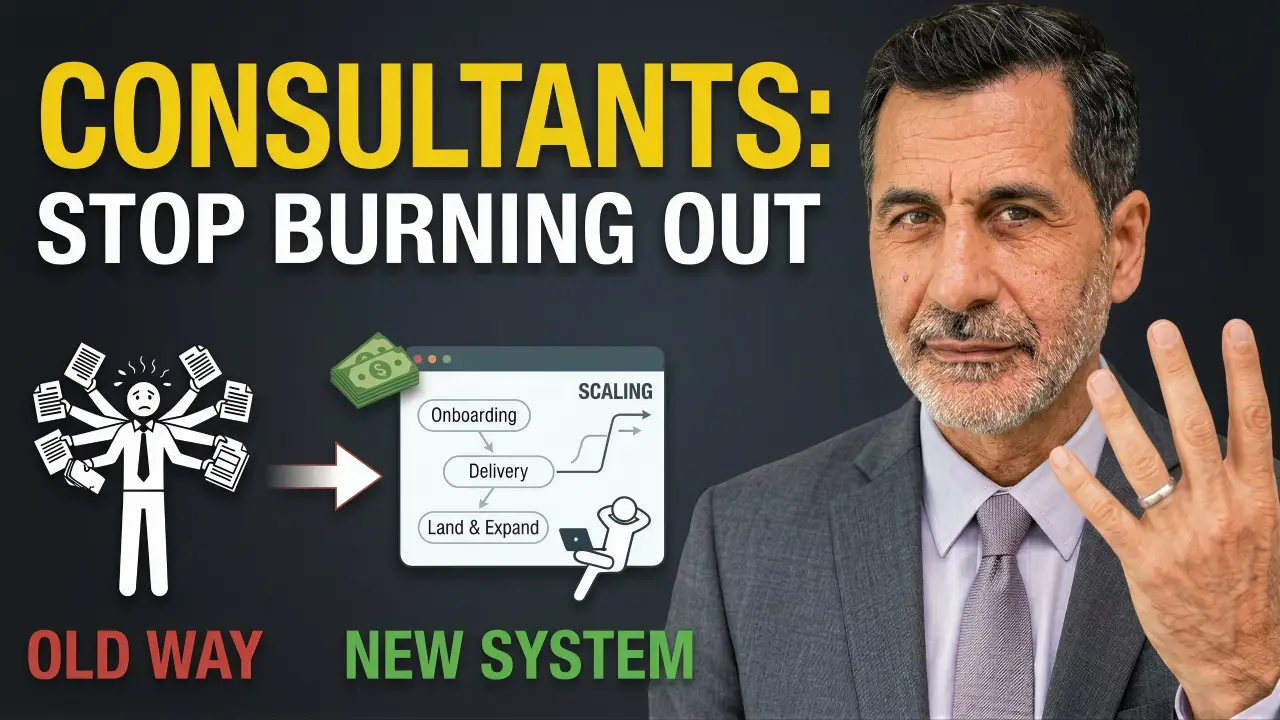
If you're still the bottleneck in your business, this video is for you.
I walk through the complete delivery and scaling framework I developed across 600+ projects while building an 8-figure consulting firm, including systems, AI, delegation, and the shift from operator to owner.
Subscribe to the Black Belt Startup Newsletter
Weekly, 5-minute insights to help you escape the 9–5, land your first clients, and grow a thriving business.