
6 Principles for Focus and Mindfulness in Entrepreneurship

Why Focus Isn’t a Discipline Problem
If you’ve been struggling with focus and mindfulness in entrepreneurship, you’ve probably tried the obvious fixes: more discipline, stricter routines, better tools.
But in many cases, that approach actually makes things worse. Focus isn’t just about effort. It’s about alignment—how you think, how you process information, and how you direct your attention. This is especially true for neurodivergent entrepreneurs, where traditional approaches to focus often create more friction than clarity.
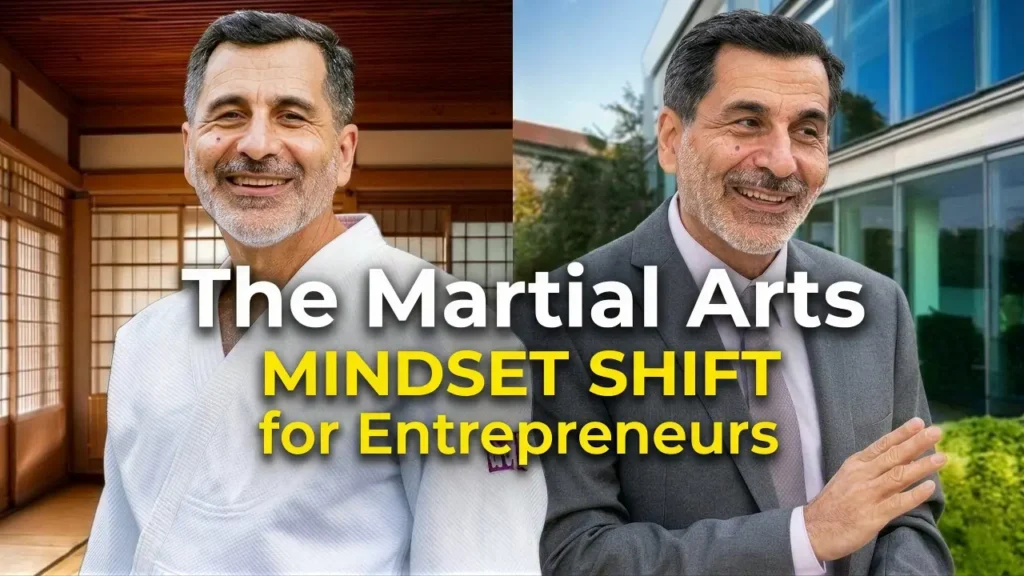
Building and scaling multiple businesses—including an 8-figure consulting firm—over the past 20+ years—and training in the martial art of Aikido long-term,I’ve seen a consistent pattern:
Tactical advice alone doesn’t solve the focus problem. Mindset does.
In this article, I walk through six principles drawn from martial arts, mindfulness, and cognitive behavioral frameworks that have helped me—and many founders I’ve worked with—build clarity, consistency, and better execution.
A Personal Lesson That Stayed With Me
Before we get into the principles, I’m going to go back to the beginnings of my journey. In tenth grade, I fell in love with martial arts. My best friend and I made a pact: no excuses. We trained relentlessly. The dojo was a 30-minute walk each way, but we never missed a class.
We had one goal—earning our black belts.
Our sensei was strict. Every class began and ended with seiza: kneeling in silence, fully present. If your attention drifted, you paid for it. Though I didn’t realize it at the time, he was training us in mindfulness.
Just months before I became eligible for my black belt, my father made a decision. My grades had slipped, and he pulled me out of training. Just like that, it was over.
For years, I saw that moment as something I lost. What I didn’t realize was that I had gained something far more valuable: the ability to reset my mind, to be present, and to approach challenges with clarity. That practice—and the principles outlined below—carried into everything I did, especially entrepreneurship.
The 6 Principles That Shape Focus and Execution
1. Beginner’s Mind (Shoshin)
Beginner’s mind is the ability to approach situations with openness and curiosity—even when you’re experienced. In business, this shows up in two ways:
- Learning new skills outside your core expertise
- Staying open to feedback within your area of expertise
Many founders embrace the first. Fewer embrace the second.
As you gain experience, it’s easy to stop listening—to clients, team members, or even the market itself. That’s where growth stalls. Maintaining a beginner’s mind allows you to adapt, evolve, and improve continuously.
2. Relaxed Alertness
Relaxed alertness is the ability to stay focused without becoming rigid. It’s not just about deep focus. It’s about shifting between:
- Detail (your craft, your service, your expertise)
- Context (market demand, client needs, business strategy)
This is especially important for founders who can hyperfocus deeply on technical work. That depth is valuable—but without stepping back, you risk building solutions without demand.
3. Learn as You Go
Many founders delay taking steps because they feel they need a complete plan. While a solid plan is important, overplanning is just as risky as underplanning. Progress happens through action, not perfection.
| Approach | Outcome |
| Overplanning | Delayed execution |
| Underplanning | Reactive decisions |
| Learn-as-you-go | Iteration and momentum |
The most effective founders decide on a direction, take action, and refine as they go.
4. Stay Organized
Focus requires structure. When your systems are disorganized, your mental energy gets consumed by tracking tasks instead of executing them.
At a minimum, founders should have:
- a task management system (Asana, Notion, etc.)
- a mechanism to track leads and sales opportunities (if you’re not ready to invest in a CRM, use my DIY CRM)
- templates/worksheets you use in marketing, sales and delivery (proposals, pitch deck, etc.), organized into a sensible folder and file structure
Without structure, it’s not just a focus issue—it becomes a burnout issue. Knowing how to avoid burnout as an entrepreneur starts with how you manage your attention and your systems.
5. Stay Empathetic
In Aikido, the goal isn’t to overpower; it’s to redirect energy. The same principle applies in business. Instead of approaching clients with a transactional or adversarial mindset, effective consultants:
- Understand client motivations
- Align with their goals
- Use that alignment to drive better outcomes
Empathy isn’t a soft skill. It’s a strategic advantage.
Let’s say that a client comes to you asking for a new marketing plan, saying the one you delivered last quarter “isn’t working.”
You could take that at face value—push back, defend your work, or escalate the conversation.
Or—you pause and ask a few more questions:
Why now?
What’s not working today?
What does success actually look like?
And you realize the real issue isn’t the plan. It’s that the existing initiatives were never fully implemented—and the client’s team lacks the capacity or skills to execute them effectively. Now the conversation shifts.
Instead of becoming defensive or reactively creating a new set of initiatives, you’re helping the client think through how to train their team, fill capability gaps, and actually execute what’s already been designed.
Same client and same starting request, but very different outcome.
6. Focus on Empowerment
At its core, martial arts—and good business—are about empowerment. But in a consulting context, empowerment isn’t one-size-fits-all. It takes different shapes depending on what the client is buying—and what they expect from the engagement.
Broadly, client empowerment through service delivery falls into three models:
| Model | What the Client Buys | What Empowerment Looks Like |
| DIY (Do It Yourself) | Frameworks, templates, guidance | Clear documentation, structured processes, and the ability to execute independently |
| DWY (Done With You) | Collaboration and support | Coaching, shared decision-making, and real-time feedback to build capability |
| DFY (Done For You) | Full execution | High-quality delivery plus transparency into thinking, trade-offs, and key decisions |
Each requires a different level of involvement—but the principle stays the same:
You’re not just delivering output. You’re strengthening the client’s ability to operate.
If, for example, a client hires you to improve their industry compliance.
- In a DIY model, you might provide a clear roadmap, templates, and guidance—so they can execute on their own.
- In a DWY model, you work alongside their team, helping them think through decisions, refine messaging, and build internal capability.
- In a DFY model, you lead execution—but still make your thinking visible so the client understands what’s driving results.
Same problem. Different expectations. Different forms of empowerment.
Key Takeaways and Actions
These principles are not abstract concepts—they’re operational.
- Focus problems are often mindset problems, not discipline problems
- Depth of focus must be balanced with strategic awareness
- Progress comes from iteration, not perfection
- Organization supports clarity and execution
- Empathy strengthens client relationships and outcomes
- Client empowerment builds long-term business value
Here’s how to start applying them immediately:
- Identify where you’re over-focusing (details vs. strategy)
- Replace rigid routines with adaptive structures
- Take action before you feel fully ready
- Build simple systems before scaling complexity
- Shift conversations from dominating to understanding
Small changes in how you think about focus can lead to significant improvements in how you execute.
Watch the Full Breakdown
I go deeper into each of these principles—and how to apply them step by step—in this video on the 6 Principles for Focus and Mindfulness in Entrepreneurship.
Final Thought
Entrepreneurship doesn’t require perfect focus.
It requires the ability to direct your attention intentionally, adjust when needed, and keep moving forward.
That’s a skill.
And like any skill—it can be trained.