How to Manage Consulting Projects Profitably: A Practical Playbook for New Consultants

Most consultants spend a significant amount of time learning how to get clients.
That’s important. No sales, no revenue. No revenue, no business.
But what ultimately determines whether a consulting business grows—or stalls—is what happens after the deal is signed.
Over the past 20+ years, and after delivering more than 600 consulting projects across small businesses and Fortune 50 companies, I’ve seen a consistent pattern. Founders are often capable, experienced, and knowledgeable in their domain, yet they struggle to manage delivery in a structured, repeatable way.
I still remember a project early in my consulting career where everything looked right on paper.
We had a signed contract for a “simple” website for a local artist. A motivated client, and a clear starting point. But within a few weeks, the project started to feel harder than it should have. New requests kept coming in, timelines slipped, and conversations became reactive instead of structured.
There was no single point of failure. Just a series of small misalignments that compounded over time. My business partner and I did manage to complete the project and make the client happy, but it cost multiple times the effort and the mental energy that it should have.
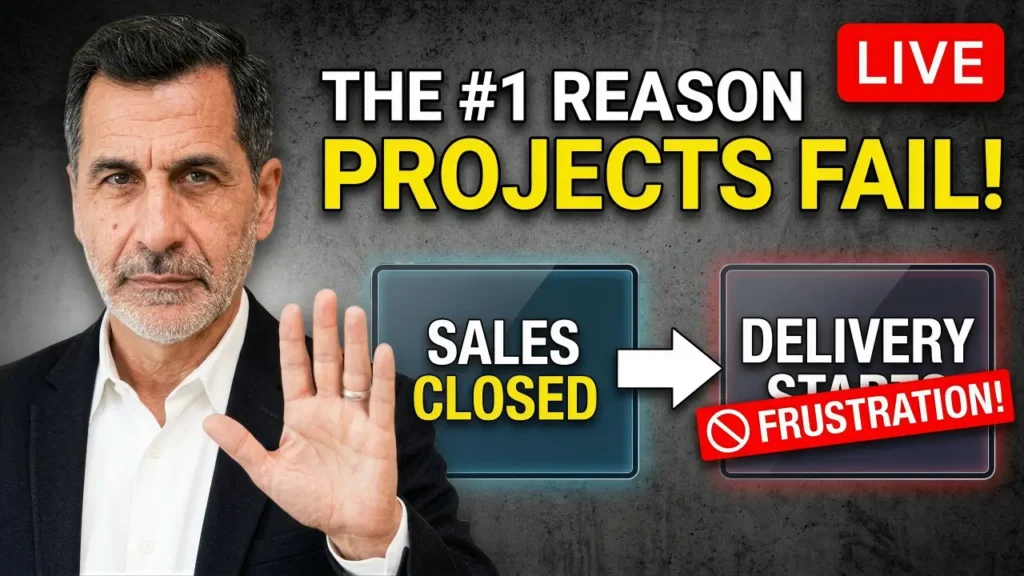
That’s when I realized: most consulting projects don’t break—they begin with enthusiasm, but gradually drift. What typically starts as a promising engagement turns into something difficult to manage—and often unprofitable.
This article outlines a practical, step-by-step execution system you can apply immediately. It is based on real-world consulting delivery and is designed to help you maintain control, protect your margins, deliver consistent results, and delight your clients.
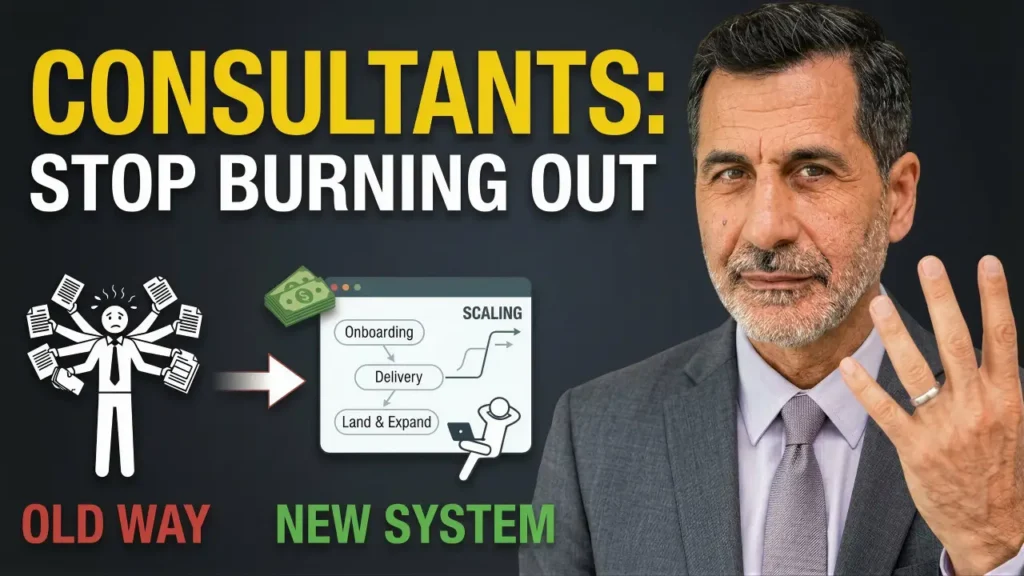
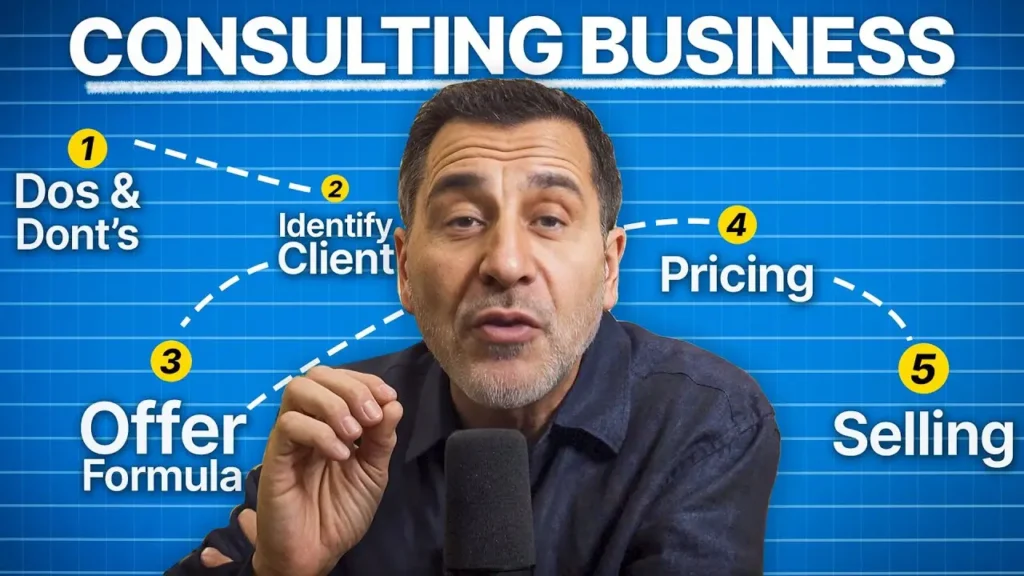
If you prefer a walkthrough format, I’ve also broken this system down in detail in my video: The 4-Pillar, No-Burnout Playbook for Successful Consulting.
Why Most Consulting Projects Become Unprofitable
Consulting projects rarely fail all at once. They fail gradually.
The root cause is not a lack of technical expertise. It is the absence of a clear execution system.
Without structure:
- Scope becomes flexible and difficult to control
- Communication lacks consistency
- Expectations diverge across stakeholders
- The consultant shifts from leading to reacting
Over time, these small breakdowns compound into larger issues that affect delivery quality, client satisfaction, and profitability.
A structured approach to project management is not about adding bureaucracy. It is about creating clarity, alignment, and repeatability.
The Execution Framework: 6 Phases of Consulting Delivery
To manage consulting projects effectively, you need a lifecycle that guides your actions from start to finish.
Overview of the Phases
| Phase | Objective | Key Outcome |
| Initiation | Align stakeholders and expectations | Shared understanding of the project |
| Planning | Structure work into phases and milestones | Clear roadmap and dependencies |
| Execution | Deliver work with visibility and momentum | Tangible progress and early wins |
| Monitoring | Track progress and manage risks | Controlled and predictable delivery |
| Closure | Finalize, enable, and extract learnings | Reusable insights and future growth |
Each phase builds on the previous one. Skipping or rushing through any of them introduces risk into the system.
Phase 1- Initiation: Establishing Control from Day One
The initiation phase begins with the kickoff meeting. This is not a formality—it is your first opportunity to lead the engagement.
In this phase, you align all stakeholders on:
- Scope and boundaries
- Deliverables and expectations
- Timeline and milestones
- Communication cadence
- Client responsibilities
One of the most common issues at this stage is misalignment among stakeholders who were not involved in the sales process. Each stakeholder may have a different interpretation of what the project includes.
A structured kickoff resets expectations and ensures everyone operates from the same understanding.
Example
In one engagement, a requirement was discussed informally during sales but did not make it into the final contract. Weeks later, a stakeholder expected it to be included. This created friction that required additional time and effort to resolve.
A proper kickoff would have surfaced and clarified this early. Check out this project kickoff template and customize for your purposes.
Phase 2 – Planning: Preventing Chaos Before It Starts
Once alignment is established, the next step is planning.
Planning is where you translate high-level goals into a structured execution roadmap.
This includes:
- Breaking the project into phases and milestones
- Identifying dependencies between tasks
- Anticipating areas where scope may expand
- Building buffer time for uncertainties
The level of detail in your plan should reflect the complexity of the engagement. A small project may require a simple outline, while a larger engagement will benefit from a more detailed structure.
Sample Project Plan Structure
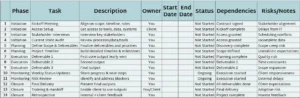
This level of clarity reduces ambiguity and allows you to lead proactively rather than reactively. Click this link to make your own copy of a sample consulting project plan.
Phase 3 – Execution: Building Momentum Through Early Wins
Execution is where many consultants lose control.
A common mistake is working in isolation and presenting a “big reveal” at the end. This approach increases the risk of misalignment and rework.
Instead, execution should focus on:
- Continuous visibility into progress
- Incremental delivery of value
- Early wins that build momentum
Example
In a website development project, instead of waiting weeks to present the full site, delivering a mobile-friendly menu page within the first few days can immediately demonstrate value and build confidence.
Early wins reinforce that the project is moving in the right direction and reduce uncertainty for the client.
Phase 4 – Monitoring: Maintaining Control Throughout the Engagement
Projects do not fail suddenly. They drift when progress is not actively monitored.
Monitoring involves:
- Tracking progress against milestones
- Identifying risks early
- Addressing blockers proactively
- Maintaining consistent communication
Effective monitoring relies on structured feedback loops, such as weekly status updates or progress reports.
Practical Communication Shift
When something goes wrong, your skills as a communicator are more important than ever. Leave your ego at the door and don’t point fingers. Instead of assigning blame:
- “We couldn’t proceed because your team didn’t provide data.”
Shift to a solution-oriented approach:
- “We identified a dependency on data that slowed progress. To avoid this, let’s assign a single owner and define turnaround timelines.”
This keeps the focus on resolution rather than fault.
Phase 5 – Closure: Finishing Strong and Preparing for Growth
Closure is often rushed, yet it is one of the most important phases. It includes both external and internal components.
Client Closure
- Deliver final outputs
- Provide training and enablement
- Ensure the client can use what was delivered
- Collect feedback
Internal Closure
- Conduct a project retrospective
- Identify lessons learned
- Standardize successful processes
Closure is also the optimal time to:
- Request testimonials
- Develop case studies
- Ask for referrals
Clients who clearly see value are far more likely to advocate for your services.
That covers the five core phases of consulting project management and how to deliver client work effectively and profitably.
Before we wrap up, there’s one more critical element to address—one that isn’t confined to a single phase, but spans the entire engagement: client satisfaction.
Client Satisfaction: Balancing Structure with Flexibility
While structure is critical, successful delivery also requires flexibility.
At times, this may require:
- Accommodating reasonable requests
- Providing additional support
- Adjusting to client preferences
Fixing a Fax Machine Delights a Client
Early in my career, a client once asked for help fixing a fax machine—completely unrelated to our scope of work. Rather than decline, I sent a junior team member to assist. The effort was minimal, but the impact on the relationship was significant.
This did not redefine our services (we didn’t pivot to offer fax machine maintenance services :)), but it strengthened trust and led to additional business opportunities with that client, along with a couple of warm introductions.
Strategic flexibility, when applied selectively, can protect relationships and often leads to additional work and referrals.
Key Takeaways and Actions
- Treat consulting delivery as a structured lifecycle, not an improvised process
- Use kickoff meetings to align stakeholders and eliminate assumptions
- Build clear project plans that anticipate dependencies and risks
- Focus on early wins to create momentum and confidence
- Monitor progress actively and address issues early
- Balance structure with flexibility to enhance client satisfaction
- Use closure to capture insights, strengthen relationships, and generate future opportunities
Next Step
If you want a deeper walkthrough of this system—including templates, examples, and practical demonstrations—watch the full video:
The 4-Pillar, No-Burnout Playbook for Successful Consulting
This will give you the full framework to manage consulting projects profitably and consistently.